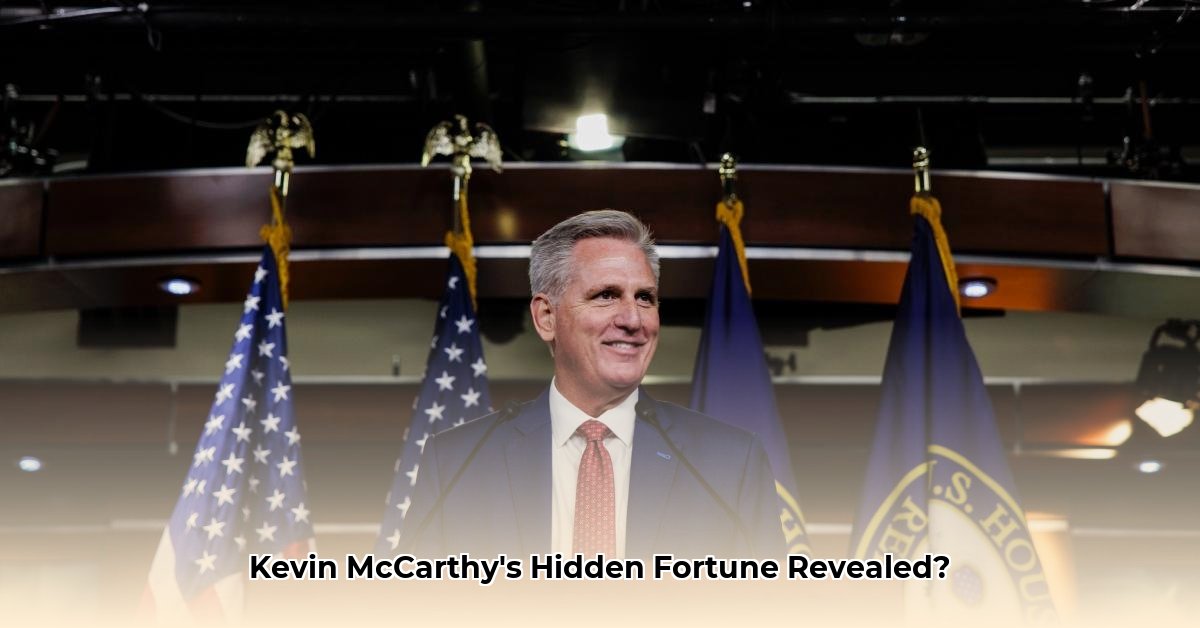
Determining the precise net worth of House Majority Leader Kevin McCarthy presents a significant challenge. While publicly available data offers some insights, the inherent limitations of financial disclosure requirements prevent accurate quantification. This article explores the available information, highlighting the methodologies used to estimate his wealth and the resulting uncertainties.
The Transparency Problem: Public vs. Private Finances
Official financial disclosure forms provide a starting point. However, these forms permit broad reporting ranges, hindering precise measurement. Imagine trying to determine someone's weight knowing only that it falls between 150 and 200 pounds—the uncertainty is considerable. Similarly, the reported asset valuations in McCarthy's disclosures lack specificity, creating a substantial margin of error.
Furthermore, significant financial details often remain undisclosed. Specific investments, complex trusts, and "blind trusts" (where the politician is unaware of the investment details) are frequently exempted from disclosure. This lack of complete information significantly restricts any accurate assessment. How can we truly understand Kevin McCarthy's financial picture when substantial portions remain deliberately hidden?
Estimating the Unknown: Methodological Challenges and Limitations
Several organizations attempt to estimate Kevin McCarthy's net worth, employing different methodologies and arriving at varied conclusions. Some rely solely on publicly disclosed salaries and assets, performing a simple summation. Others attempt a more holistic approach, incorporating estimates of income from undisclosed sources like investments. However, such estimations are inherently speculative and prone to considerable inaccuracies.
| Methodology | Advantages | Disadvantages | Estimated Net Worth Range (Illustrative) |
|---|---|---|---|
| Public Information Only | Straightforward; uses verifiable data | Incomplete picture; omits many potential income sources | $500,000 - $1,000,000 |
| Holistic Approach | Attempts broader inclusion of potential income | Highly speculative; relies on numerous assumptions | $1,000,000 - $5,000,000 |
The vast discrepancy between these estimated ranges underscores the inherent limitations. How reliable are these figures? Are they accurate reflections, or merely educated guesses? The answer remains elusive. This begs the question: How can the public hold their elected officials accountable without more transparency?
The Imperative for Greater Transparency: Accountability and Conflict of Interest
The difficulty in determining Kevin McCarthy's net worth highlights a crucial deficiency: the lack of transparency in political finance. More detailed financial disclosures are needed to provide a more accurate and less speculative understanding of politicians' financial situations. This is not merely a matter of public curiosity; it’s fundamental to accountability and conflict-of-interest prevention.
Imagine a scenario where a politician's personal investments might influence their votes on critical legislation. Greater transparency would help prevent such conflicts. It's essential to ensure that our elected officials act in the public's best interest, not to serve their personal financial gain. A robust democracy necessitates such transparency. Why do we tolerate a system that operates with such significant informational gaps?
Improving Financial Disclosure: A Path Forward
The challenge of assessing Kevin McCarthy's net worth exposes the shortcomings of the current system. We require stricter regulations, robust enforcement mechanisms, and a stronger commitment from politicians to ethical financial conduct. Only then will we achieve a clearer, more honest understanding of the finances underlying political power. This is a crucial step towards a more effective democracy. The pursuit of greater transparency is an ongoing process demanding continued attention.
Key Takeaways:
- Publicly available data provides incomplete insights into politicians’ finances.
- Resources like OpenSecrets offer valuable information, but have inherent limitations.
- Many assets, such as primary residences, remain undisclosed, hindering accurate assessments.
- Analyzing net worth requires careful interpretation and acknowledgement of data gaps.
- Enhanced transparency in political finance is essential for accountability and public trust.